Peppered Moths
- Created:: 2023-07-02
- Status:: #soil
- Foundation::
- Project::
- Topic:: animals evolution natural selection
What is a Peppered Moth?

A peppered moth (Biston betularia) is a species of moth that is known for its ability to adapt its coloration in response to changes in its environment. The name "peppered moth" refers to the speckled pattern on the wings of the adult moths, which resembles pepper sprinkled on a light-coloured background.
Adaptation and Color Variation
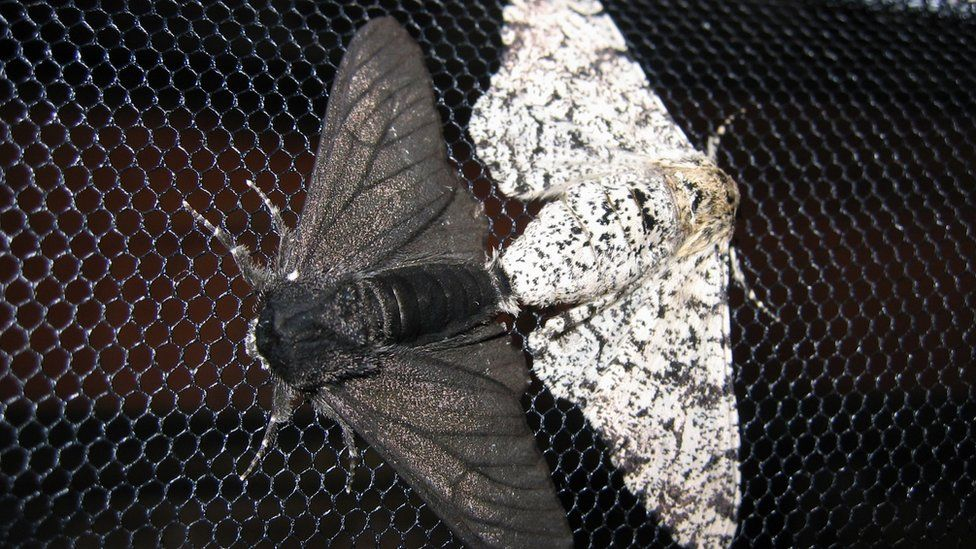
The coloration of peppered moths can vary between light and dark forms. The light form, known as the typica morph, has pale wings with small black specks scattered across them. This coloration helps the moths blend in with lichen-covered tree bark, which was their natural habitat before industrialization.
However, during The Industrial Revolution in England in the 19th century, pollution from factories caused widespread darkening of tree trunks due to soot deposition. This change in the environment led to an increase in the population of dark-colored individuals known as carbonaria morphs. The dark coloration allowed these moths to blend in better with the newly darkened tree trunks, providing them with a survival advantage against predation.
Famous Example of Natural Selection
The peppered moth is considered one of the most well-known examples of natural selection due to its rapid adaptation to changing environmental conditions. The phenomenon was first observed by British biologist Bernard Kettlewell in 1953.
Kettlewell conducted experiments where he released both light and dark morphs of peppered moths into different environments with varying degrees of pollution. He found that in areas heavily polluted by soot, birds were more likely to capture and eat light-coloured moths, while dark-coloured moths had higher survival rates. In cleaner areas, light-coloured moths had higher survival rates.
These findings provided strong evidence for natural selection favouring different colour morphs depending on the prevailing environmental conditions. The study also highlighted the significant role that predators play in shaping the population dynamics of prey species.
Further Research and Controversy
While the peppered moth example is often cited as a textbook example of natural selection, there has been some controversy surrounding Kettlewell's experiments. Some critics argue that his methods were flawed and that the selective predation observed in the experiments may not accurately represent what happens in natural populations.
However, subsequent studies and research have provided additional support for the phenomenon of industrial melanism in peppered moths. DNA analysis has confirmed that the colour variation observed in these moths is indeed genetically controlled.
The peppered moth remains an important case study in evolutionary biology, highlighting the dynamic relationship between organisms and their environment and the role of natural selection in driving adaptation.